Jan 26, 2009
Kung Hei Fat Choi!
Jan 22, 2009
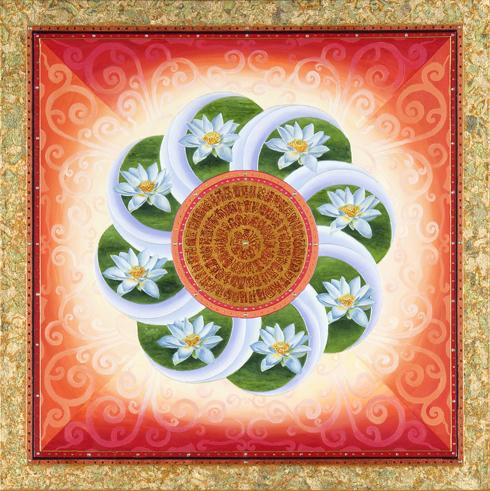
Mandala: dancing around the center
The word mandala comes from Sanskrit means circle, center, circumference, sacred circle or magic circle. In eastern spiritual traditions, a mandala is a form of sacred art that depicts the totality of the self. Swiss-German psychoanalyst Carl Gustav Jung found the mandala – an ancient archetypal manifestation that appears in Eastern and Western religions, mythology and rituals – to be a powerful tool for growth and transformation, a symbol of wholeness. Seeing the mandala as representing both the self and world.
The universe itself is a mandala. The earth, sun and moon are round. Everything alive – plants, animals and human beings – consists of cells. Each cell is a mandala. Even the seasons and the life cycle of human beings is a circle, so it is in everything where power moves.
Circle is the symbol of one, wholeness and centering. It represents infinity and eternity, having no beginning and no end.
Finding your true center
We perceive the conscious experience of our center as indescribable happiness. To help to feel one’s own center is to stay conscious, no matter what might happen, no matter what one does at any time, to watch oneself consciously. When we are truly got in touch with our true center, we are in total peace. Imagine you are sitting in the eye of hurricane, you feel the sense of peace, stillness and calmness. If you begin to move away from the center, everything will be chaotic and distorted. And until you return your true center, you can never gain true perceptions.
Physical movements like dancing are a great to way to find one’s true center, especially the whirling dance of the Islamic dervishes. They spin and whirl in order to find in their center the calmness. If we do not succeed to finding the center, we become dizzy. When we connect our center and dance, we are able to spin around almost without limit and self-forgettingly with music.
Creating mandalas as a self-healing tool
Mandala connects us with our true center and fully in the energy of NOW – the present moment. Creating mandalas is an active meditation for the purpose of personal growth and self healing. When we work with the mandala we may experience moments of clarity and a reality of harmony, peace and inner happiness.
The best place of creating mandalas is a private space where you will not be interrupted for at least one hour. Light a candle and play some meditation music may heighten your ability to concentrate.
To begin drawing a mandala, select any coloring materials that you like, e.g. color pencil, crayon, acrylic paint, water color etc. It can be done on a white drawing paper, canvas or a cloth.
Do a short meditation to relax your mind before you start. You may notice forms, colors, and shapes dancing before your mind’s eye. Using as little thought as possible; select a color, form, or feeling from your heart as the starting point for your mandala. As guided by your inner voice, you may feel that the color chooses you.
Draw a circle and begin to fill it with colors and forms. You may begin in the center or around the edge of the center. There is no right or wrong of creating a mandala. Work until you feel the mandala is completed.
Dating your mandala for future reference. You may end your meditation here, or to feel what you have experienced. Then give your mandala a title and write down the messages it delivers.
Creating a mandala without thought and fully experience the present moment is the key of self awakening. Listen to your heart and guided by your intuition, the mandala reflects your true self. That is a perfect way to reconnect your inner creativity. You will be amazed how effortless you could create a beautiful mandala painting.
Jan 18, 2009
Mandala & Circles
According to David Fontana, the most basic of all mandalas is the circle, an intriguing symbol that has no beginning and no end. It is the still centre of the turning world, the magic circle that defines and protects a sacred space within which one finds tranquillity and peace. The circle of mandala is a primal symbol for all that exists. It is the symbol of the sun, the giver of light, and of the full moon, the discloser of dark mysteries, the wheel of life, the symbol of ultimate perfection, the tunnel between this world and the world to come, the symbol of eternity. Although the circle may contain other shape within it, such as the square and the triangle, and sometimes may even be bounded on the outside by one or other of these shapes, the circle remains the primary feature of all mandalas. Without the circle, there is no mandala. But once the circle is drawn, then other symbols can be added to it. (Source: Meditating With Mandalas: 52 New Mandalas to Help You Grow in Peace and Awareness)
The symbolic meaning of circle in a mandala is completion, movement, perfection, with no end and no beginning.
The pattern of a mandala -- a circle with a center -- reaches far beyond a two or three dimensional art form. Examples of mandalas are found in nature. Every cell in our body, for instance, is a living mandala. So is the iris of our eye, a snow crystal, a bird's nest -- even a bicycle wheel. Look around. Can you see more mandala in your surroundings?